


In the news
1. AI: mitigating the costs of zombie firms?
According to Morgan Stanley analysts, AI may kill 200,000 European banking jobs by 2030. The Financial Times reported it’s about 10 percent of Europe’s bankers. Predicted job losses are concentrated in back-office roles such as compliance and risk management. UBS, a Swiss bank, is already using AI to turn its analysts into avatars that can present to clients.
To put that into perspective, ten percent of the Canadian banking workforce amounts to roughly 30,000 jobs. Canada’s big five banks are advanced users of AI. RBC uses AI for personalizing financial advice, optimizing corporate trading, credit adjudication, identity verification, and other internal tools to boost efficiency. RBC’s CEO told investors he’s targeting $1 billion in revenue growth or cost-savings from the bank’s multi-year AI investments, going back to the 2016 creation of RBC Borealis, its in-house research institute.
Critics of financialization should be thrilled. There are people who think financialization is something like a tax on the real economy—that it generates profit by moving money around, rather than by creating anything of real value. I mostly don’t believe that, but I’ll suspend my disbelief: isn’t it extra good, then, for human capital to be reallocated to more productive work? That is one of the problems with zombie firms, after all.
2. United Kingdom wants alignment with EU, except on financial services
According to a report from the Financial Times, UK ministers will soon propose legislation to recognize select EU laws to boost trade with the EU. But financial services will be spared from Brussels’ rulebook. Leaving the EU wasn’t supposed to be good for banks. Of late the UK has been charting its own course, replacing a “cottage industry of checkers and blockers” with deregulators and boosters of economic growth. While not everyone is a fan, imperfect can be better than unrelenting institutional disorder.
In some parts, the EU has a reputation for being more concerned with its history than its future, its chief output being laws that suffocate the forces of creative destruction. In other parts so small you may fail to notice them, the EU is “the world’s most underrated libertarian project.”
3. UK catching up on crypto policy
The UK has published proposals to comprehensively regulate crypto. Until now, crypto has been only partially regulated in the UK. Supervision was limited to preventing financial crime and inappropriate marketing of products and services. But the UK wants lead the world in digital asset adoption, and so it seems to be breaking down the wall between crypto and traditional financial services.
Law firm A&O Shearman published a short and helpful overview, noting that crypto-asset regulation in Europe and the United States may be making the UK a bad spot to start a crypto business. In Canada, a comprehensive regime is emerging with the tabling of the Stablecoin Act, which will stand alongside crypto-related measures under securities law and Proceeds of Crime (Money Laundering) and Terrorist Financing Act. One Canadian crypto-asset trading platform says more can be done, such as letting Canadians hold cryptocurrencies like bitcoin in their TSFAs and RRSPs.
Wonkier stuff
1. Carolyn Wilkins on central bank independence
The Bank of Canada is not the best example of central bank independence. Published in Canadian Public Policy, Wilkins covered the history of the Bank of Canada and how it can evolve to become more politically independent.
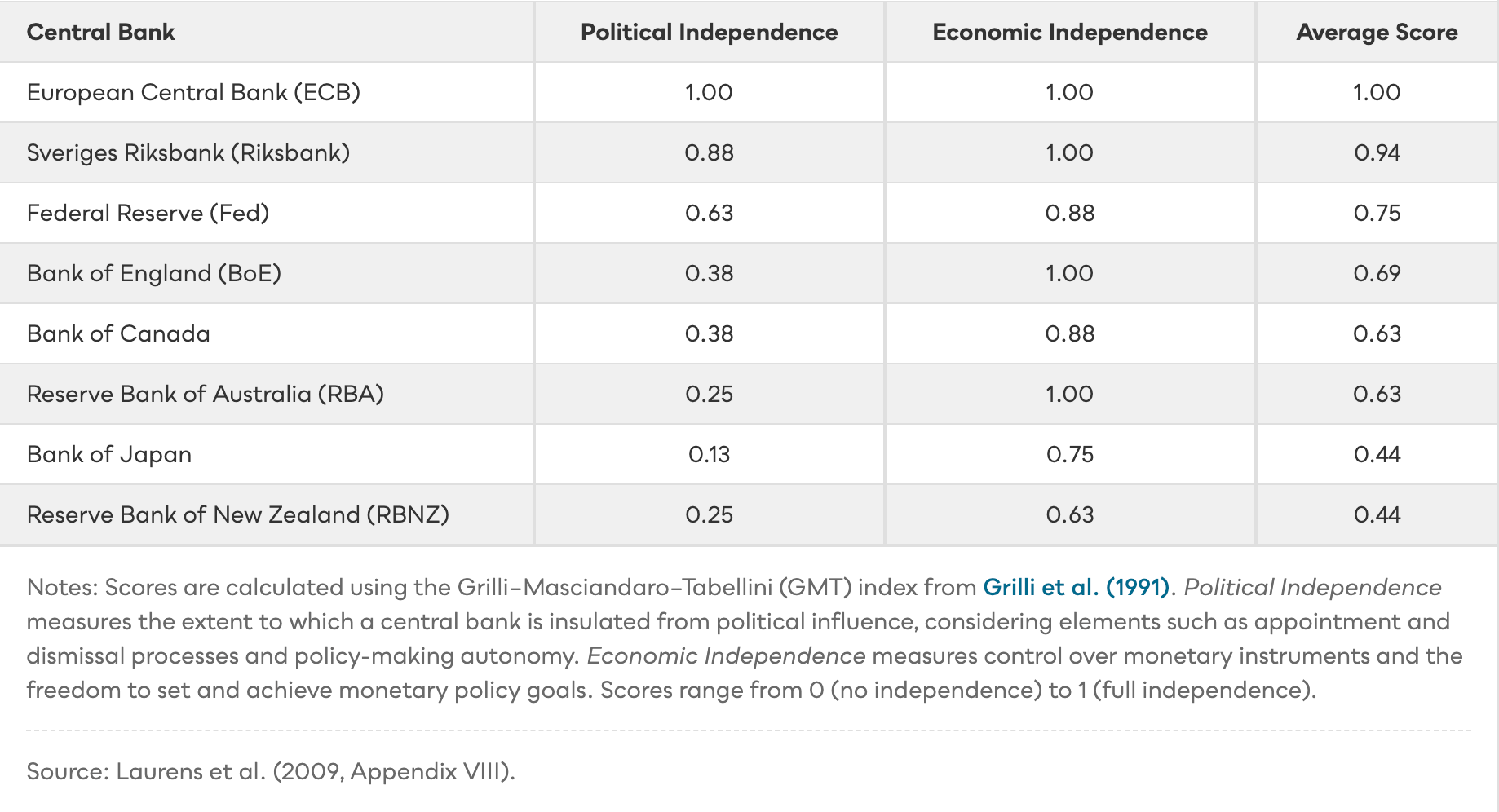
Canadian money has been politicized from time to time. Wilkins implied by citation that the Bank of Canada was established for political reasons—not because Canada needed a lender of last resort to prevent financial crisis, nor because the suspension of the gold standard would result in harmful inflation. During the second world war, the Bank of Canada bought government debt to fund the wartime effort. In the postwar period, the Bank of Canada butted heads with John Diefenbaker’s government over fiscal and monetary policy. This test of independence led to the resignation of James Coyne, the Bank of Canada’s governor at the time.
After a deep dive into the monetary operations of the COVID-19 pandemic, Wilkins made recommendations to protect the Bank of Canada’s independence:
Move away from inflation targeting as a negotiated policy objective and toward inflation targeting as a legislated one.
Create a formal framework for quantitative easing so that monetary operations are more rationalized, can be evaluated, and abide by a pre-defined cessation strategy.
Make the Bank of Canada’s forward guidance more contextualized, comprehensive, transparent.
Pre-define the rules of the game for fiscal-monetary coordination between so that people don’t get the wrong idea.
Conduct regular and independent reviews of the Bank of Canada’s monetary policy framework.
2. Do stablecoins pass a cost-benefit analysis?
Someone I know who’s done serious time in the financial regulatory circuit shared a paper by David Lam, who argued the answer is no. Though the contours of his argument are stale, the particulars are refreshing in a southeast Asian context.
The primary risk for Lam is illicit finance. Sanctioned states use crypto-assets to sell weapons. Criminals use it to launder money. According to Lam’s back-of-the-envelope arithmetic, illicit finance is a bigger problem in crypto than it is traditional finance. To size up the risk, he uses an estimate of the proceeds of “pig butchering” scams: $US27.8 billion per year between 2021 and 2023, with 78 percent of that involving USDT, a stablecoin issued by Tether. The problem is less stablecoins, per se, and more that it’s relatively easy for anyone to transact with them: even if a shady blockchain address is blacklisted, a shady user will get a new one.
For Lam, the benefits of stablecoins are overrated. He wrote they’re mostly used for speculative trading and gambling, the latter of which is limited or banned in southeast Asia. The promise of making payments work better is also dubious in southeast Asia, where payment systems are already fast and cheap.
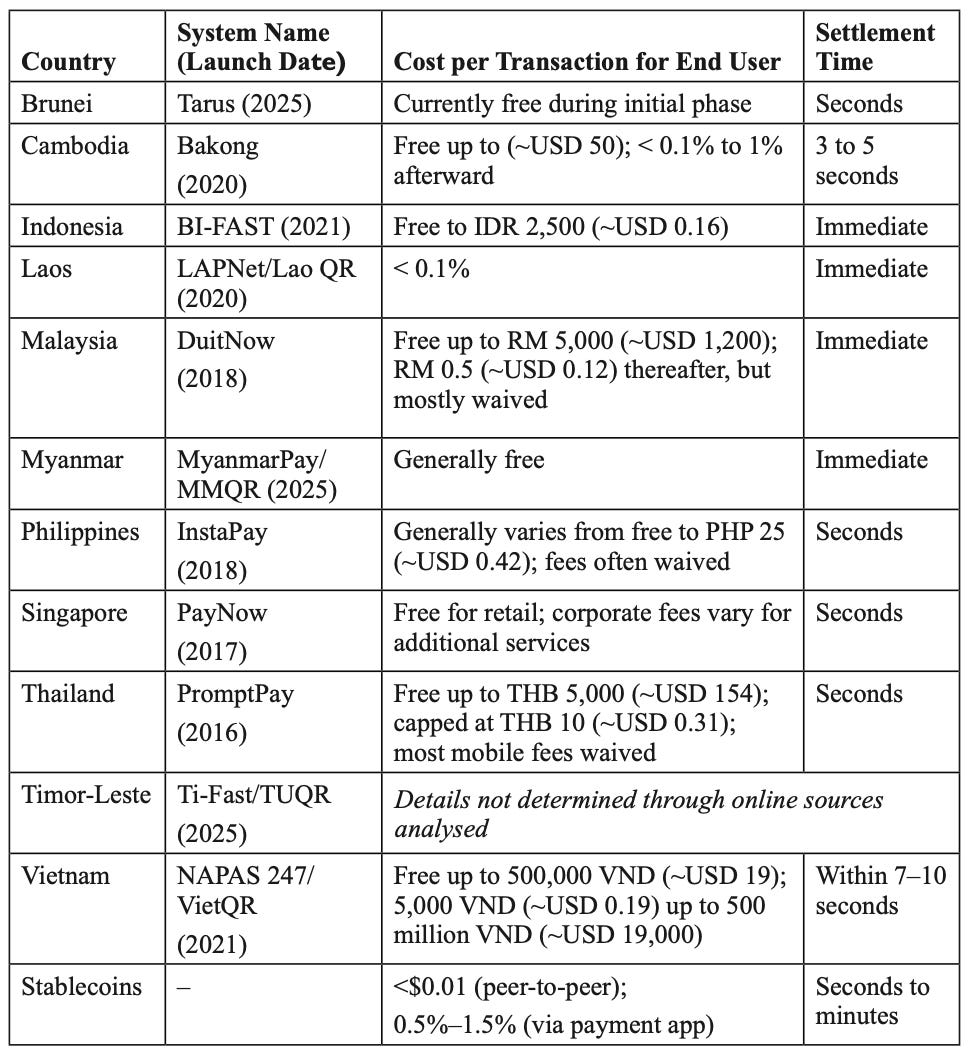
Lam’s cost-benefit analysis is perfunctory and, therefore, unpersuasive. He estimated the benefits of stablecoins to be about $US18 billion in 2025, using the combined revenue of Circle and Tether, the biggest stablecoin issuers, as a proxy measure. Then he compared his estimate of the benefits to the average annual dollar-value of pig butchering scams from 2021-2023, which according to other researchers was about $US28 billion. He argued the costs are even higher because the losses should “include a host of other illicit activity such as hacks, ransomware and darknet markets.”
There’s so much wrong with this that I don’t even know where to begin, but there are nuggets of insight. Why stablecoins when a country has an instant retail payment system, such as Canada’s forthcoming real-time rail? A lot of good can come from tokenized assets and blockchains if there are checks on illicit finance—like JP Morgan’s deposit token, JPM Coin, to “which access is limited exclusively to whitelisted addresses belonging to institutional customers of JP Morgan, who have already met the bank’s KYC screening requirements,” wrote Lam.
Lam’s is a familiar bias: rather than traditional finance conforming to the normative vision of crypto, crypto needs to conform to the normative vision of traditional finance. In other words, the future ought not to be permissionless, without borders, and free; it ought to be permissioned, enclosed, and controlled. Lam isn’t on a lonely island. Don’t be fooled by any public pronouncements coming from anywhere but the United States. His way of thinking is shared by many smart and serious people whose job it is to decide the fate of stablecoins and whatever comes next.
Detours
1. Marshall McLuhan rising in status?
Who says Canadians don’t have sway on the world stage? Andrew McLuhan, grandson of Marshall McLuhan, wrote a piece for a16z, reviving the “tetrad” or “laws of media” to make sense of media today. Tyler Cowen also name-dropped McLuhan in his Free Press column about the declining importance of reading in Western culture. Nick Ripazatrone connected the dots between McLuhan and Peter Thiel’s “antichrist” interview with Ross Douthat last year.
2. Selling onions on the Internet
Peter Askew sells onions on the Internet not because he’s an allium aficionado, but because vidaliaonions.com was available. “The way Faulkner treats his characters, I treat domain name projects,” he wrote. “I buy them with an intention to develop. And I let them take the lead. They’re the inspiration for the business itself. They guide me towards what they need to become. I’m just the dude behind the keyboard (sorta).”